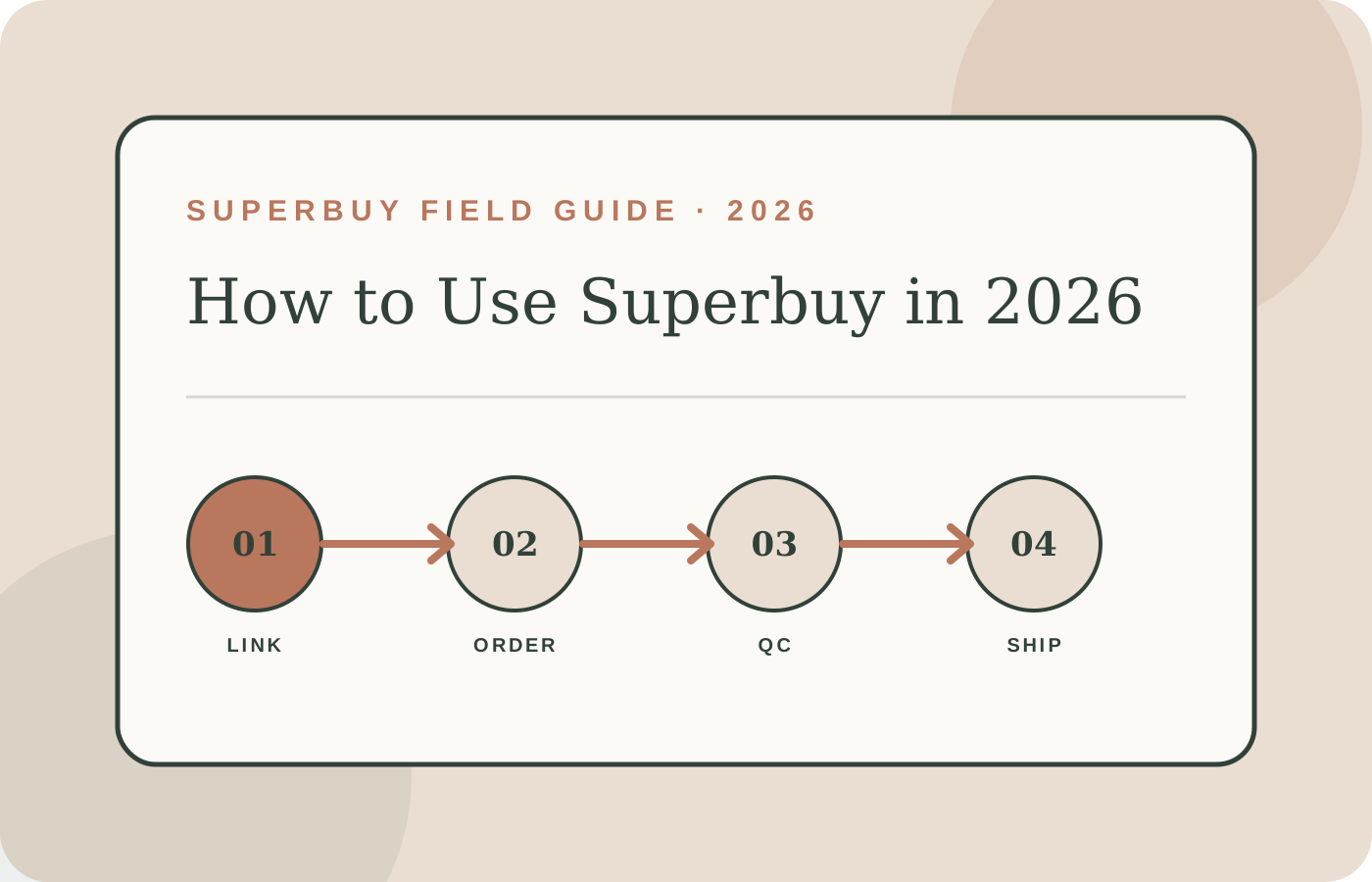
Start with the product page, not the agent checkout
Superbuy is a shopping and forwarding agent rather than the original marketplace seller. That distinction matters from the first click. The seller controls the listing, available variants, domestic dispatch and after-sales conditions; Superbuy helps place the order, receive the item, photograph it and prepare an international parcel. Begin on the Taobao, 1688, Weidian or other supported product page. Read the seller's size chart, option labels, minimum quantity, domestic shipping note and any warning that an item is customized or cannot be returned. Save screenshots of the exact version you intend to buy.
Do not treat the lowest number in a multi-variant price range as the price of every option. On 1688, the displayed amount can depend on quantity, colour, size or a wholesale tier. On image-heavy marketplace listings, the main photograph may represent several products while the selected option names are abbreviated. Write down the intended colour, dimensions, model and quantity before pasting the link into Superbuy. This simple record gives the purchasing agent a testable instruction and gives you evidence if the created order does not match the listing you reviewed.
Paste the link and rebuild the order carefully
After you paste a supported product link, Superbuy normally imports available information into an order form. Imported details are a convenience, not a substitute for verification. Compare the product name, option list, unit price, quantity and Chinese domestic delivery charge with the source page. If the page cannot be imported cleanly, use the manual or expert enquiry route and describe the product in measurable terms. A useful note says “black, size 42, 27 centimetre outsole, one pair”; a weak note says “same as picture” and leaves every important choice open to interpretation.
Only add requests that the seller or warehouse can realistically follow. The purchasing agent can communicate a selected variant or an important specification, but cannot guarantee material quality that the seller never defined. For apparel, record body measurements and compare them with the seller's garment chart instead of relying only on S, M or L. For accessories, confirm dimensions and hardware colour. For electronics, check plug type, voltage and battery status before ordering because those details can later restrict shipping routes even when the product itself is inexpensive.
Understand the first payment before submitting
The first payment usually covers the merchandise and any Chinese domestic shipping needed to move the seller's parcel to the Superbuy warehouse. It is not the final landed cost. International freight is calculated later, after the item arrives and you decide which stored goods to ship together. Keep separate spreadsheet columns for product price, seller delivery, optional services, payment or currency-conversion costs and international freight. Mixing them into one early estimate makes it impossible to see which stage caused a difference.
Superbuy publicly describes standard purchasing from major marketplaces such as Taobao, Tmall, JD and 1688 as having no purchasing service fee, while special channels or optional services can follow different rules. Always use the live checkout as the controlling source because eligible platforms, fees and promotions can change. Before paying, inspect the line items and account balance rather than reasoning from a headline such as “zero service fee.” A zero fee for one service does not remove the seller's price, domestic shipping, added photos, packaging or international delivery.
Track the seller stage without guessing at silence
Once the order is placed, the seller still needs to accept it and dispatch a domestic parcel. A quiet order page does not automatically mean the package is lost. Check whether the item was described as pre-sale, customized or subject to a delayed release. Watch for agent messages requesting clarification, an additional payment or approval of a seller condition. Answer those messages promptly because a purchasing agent should not guess between two colours or approve a price increase on your behalf.
If a seller misses the expected domestic dispatch window, ask a specific question: whether the seller accepted the order, whether a tracking number exists and whether the item is still available. Keep cancellation decisions tied to the marketplace's after-sales window and the item's return eligibility. Reordering immediately from another seller can create duplicate stock if the first parcel was already moving. The useful habit is to maintain one short timeline containing order date, seller response, domestic tracking and warehouse arrival rather than opening several disconnected enquiries.
Use warehouse QC as a decision gate
Warehouse arrival is the first point at which you can compare a physical item with the order record. Review every standard QC photo at full resolution. Confirm the selected colour and model first, then compare proportions, logos or prints, stitching, visible surfaces and included accessories. For footwear and fitted clothing, measurements are often more useful than general appearance. If the standard angles do not answer an important question, request one targeted detail photo before the seller-return window closes.
A precise photo request describes one view and one purpose: “place the insole beside a ruler and photograph the full measurement” or “show the wash label in focus.” More photographs are not automatically more evidence. Decide in advance what result would make you keep, exchange or return the item. If a visible flaw is minor but international return cost is high, keeping it may be rational; if the wrong model or measurement makes the product unusable, act while the domestic after-sales route is still available. Do not submit questionable goods for international shipping and hope the problem will resolve later.
Build the parcel around route compatibility
When several items are in storage, consolidation can reduce repeated first-weight charges, but the largest possible parcel is not always the cheapest or safest. Group goods by destination, urgency, fragility and shipping classification. Ordinary textiles may have broad route choice, while batteries, liquids, cosmetics, food, magnetic products or oversized boxes may be restricted. Combining one sensitive item with several ordinary items can remove lower-cost lines for the entire parcel. Test a consolidated scenario and at least one sensible split before submitting.
Packaging decisions should follow the item rather than a universal rule. Removing an unnecessary shoe box may reduce dimensional weight, while a structured bag or fragile accessory may need its protective support. Vacuum packaging can help soft textiles but should not be used where compression can deform the product. Record which original packaging must remain and which can be removed. The goal is the smallest protected parcel that remains eligible for a suitable route, not simply the smallest carton the warehouse can create.
Compare live shipping routes as complete offers
A route should be compared using chargeable weight, delivery estimate, tracking, size limits, accepted item types, customs model, insurance availability and compensation terms. The cheapest first-weight figure is not enough. Some routes bill in steps, some use volumetric weight and some impose maximum dimensions. Enter the destination and realistic parcel details in the current calculator, then repeat the comparison on the actual submission screen after packing. Route names and eligibility can change, so an old community recommendation is context rather than a current quotation.
The first international amount can be a deposit based on estimated weight and dimensions. After packaging, the carrier or warehouse verifies the parcel and the final amount can be adjusted. Save the estimate, selected route, packed dimensions, paid amount and final adjustment. After two or three parcels, those records reveal which product types create volume and which route assumptions were accurate for your country. That personal evidence is more useful than asking for one universal Superbuy price per kilogram.
Finish with accurate records and a delivery check
Use accurate product descriptions and values when completing parcel information. Customs rules belong to the destination country, and a route label does not make inaccurate declarations safe. Keep the order page, warehouse photos, parcel number, declaration, payment record and carrier tracking in one folder. If tracking pauses, identify the last physical scan and responsible carrier before opening an enquiry. A gap between electronic information and a carrier acceptance scan is different from a parcel that has already entered the destination network.
At delivery, photograph an externally damaged carton before opening it and preserve labels and packaging until the contents are checked. Compare received items with the warehouse record and note the actual delivery date. Then update your spreadsheet with final freight, any adjustment, transit time and problems. This last step turns a one-off purchase into a repeatable method. The purpose of a Superbuy workflow is not merely to place an order; it is to control decisions while they are still reversible and keep evidence when they are not.
Questions readers ask before committing
Can I use Superbuy without reading Chinese? +
The agent interface and translation tools reduce the language barrier, but automated translations can blur variant names and seller conditions. Verify option images, measurements and numbers, and add a concise purchasing note when the source listing is ambiguous.
Do I pay international shipping when I buy the item? +
Normally no. The first stage covers the product and applicable Chinese domestic delivery. International shipping is selected and paid after warehouse arrival and parcel submission.
Should I ship every warehouse item together? +
Not automatically. Compare consolidation with sensible splits when goods have different restrictions, fragility, urgency or dimensional impact.
What should I check first in QC photos? +
Confirm the exact option and visible measurements before cosmetic details. A beautiful item in the wrong size or version is still the wrong order.
Is the first shipping payment always final? +
It can be an estimate or deposit based on provisional parcel data. Check the final verified weight, dimensions and any later adjustment in your account.
What records should I keep? +
Keep source screenshots, order details, agent messages, QC images, parcel declaration, payment records and tracking scans until delivery and any claim period have finished.
Written from current public Superbuy shopping, warehouse, fee, freight and help information checked on September 20, 2026. Service availability, route rules and destination requirements can change; confirm the live account screen before paying.