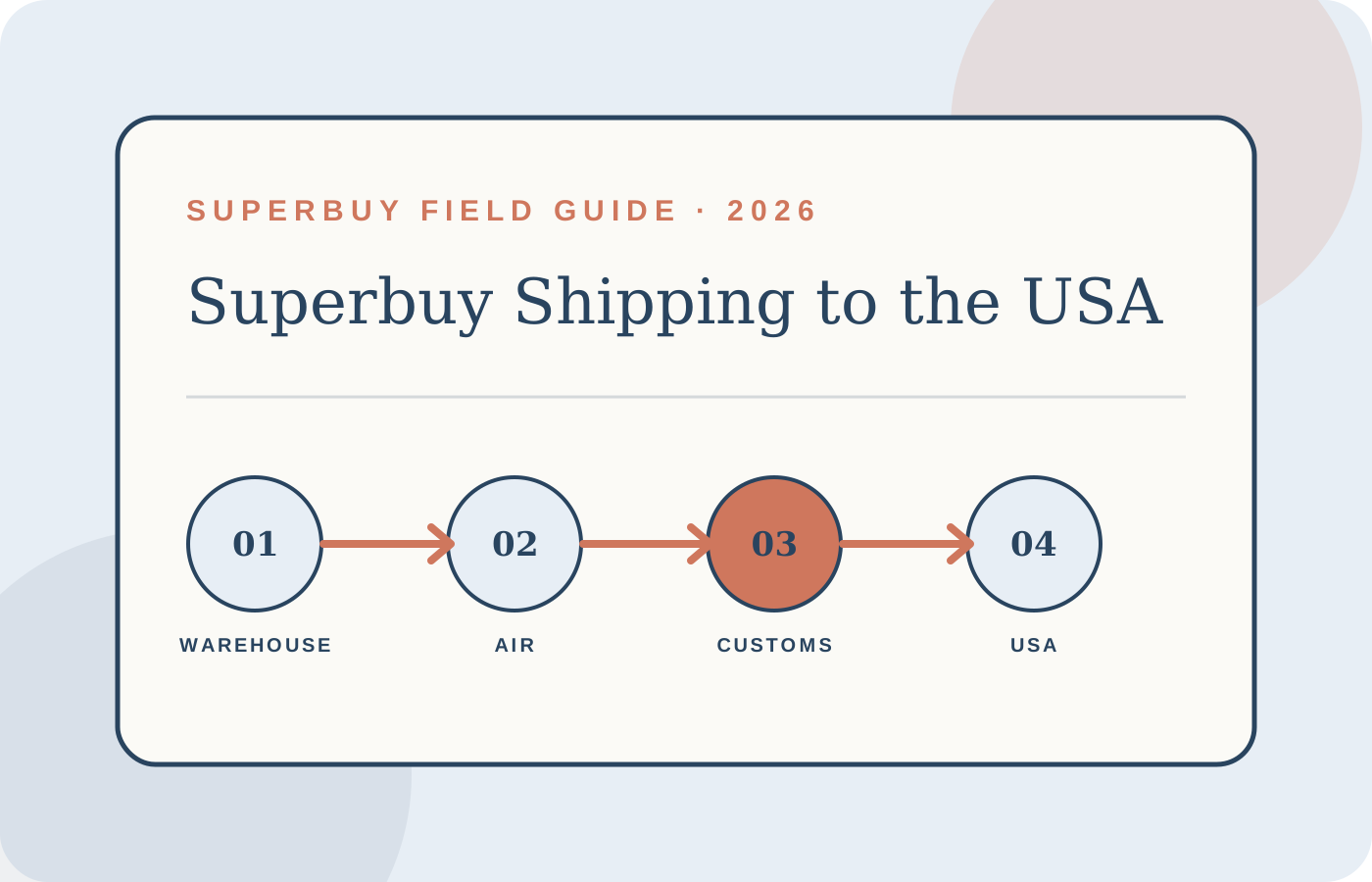
Why one USA shipping price cannot be accurate
A Superbuy product page does not contain the final international shipping price because the carrier bills a packed parcel, not an isolated listing. The amount depends on destination, actual weight, carton dimensions, chargeable-weight rules, product classification and the routes available on the submission date. Two buyers can order the same shoes and see different totals because one keeps the box, the other consolidates clothing, and their ZIP codes or route eligibility differ. Treat any universal “price per kilogram” as a rough historical example rather than a quote.
Build a pre-purchase range instead. Estimate the item's warehouse weight, then consider the packaging likely to remain. For bulky footwear, puffer jackets or decorative boxes, estimate dimensions as well as mass. Add a buffer for the shipping carton and protective materials. Enter the United States and product category in the live calculator, compare several lines, and make sure the purchase still works if the lowest estimate disappears. The actual parcel-submission screen after warehouse packing is the decision point.
Actual weight and dimensional weight compete
Carriers sell both lifting capacity and aircraft or truck space. A light parcel that occupies a large carton can therefore be charged by volumetric weight. Superbuy's public planning calculator has shown the common air-cargo reference formula of length multiplied by width multiplied by height in centimetres, divided by 6,000. A 50 by 40 by 30 centimetre carton produces ten kilograms of volumetric weight even if a scale shows much less. Individual route rules and divisors can differ, so confirm the current line terms.
Reduce empty volume intelligently. Removing a retail shoe box may help, but shoes still need protection against crushing. Vacuum packaging can compress soft clothing, while it can damage structured items. Ask for unnecessary outer seller packaging to be removed and retain packaging that protects shape, glass, hardware or delicate surfaces. The best target is not the smallest possible box; it is the smallest protected parcel that remains within a suitable USA route's size and item limits.
Read first-weight pricing as steps, not a smooth rate
Many international lines use a first chargeable unit and continued-weight increments. A parcel below the first unit may still pay the full initial amount, while crossing a later boundary by a few grams can trigger another complete increment. This is why removing a small insert sometimes changes nothing and removing a heavier box sometimes matters. Calculate the full quote for the expected chargeable weight rather than comparing only the advertised first-weight figure.
Consolidation often uses the initial unit more efficiently, but it can also increase volumetric weight or introduce a restricted item. Compare at least two structures: all compatible items together and a split that isolates a bulky or sensitive product. Include any packaging service, insurance and coupon in both totals. A coupon attached to a more expensive route does not automatically make that route cheaper after all charge steps are included.
Choose among eligible USA routes, not familiar names
The route list can change with parcel contents, weight, dimensions and service availability. Compare only the lines currently offered for the packed parcel. Record the estimated delivery window, tracking coverage, maximum weight and dimensions, accepted item types, customs model, insurance availability and compensation ceiling. A route popular in an old haul report may no longer have the same price, restrictions or last-mile partner. The live description in your account should control the decision.
Match the route to the risk. Fully tracked service is valuable when the contents are difficult to replace or when delivery evidence matters. A lower-cost line with limited compensation may fit ordinary, low-value clothing. Time-sensitive gifts need a buffer beyond the advertised transit window because warehouse processing, export handoff, customs and local delivery are separate stages. No estimate can guarantee a delivery date, so avoid submitting an urgent parcel at the last possible moment.
Classify restricted goods before consolidation
Batteries, electronics, liquids, creams, powders, food, cosmetics, magnetic products and some branded goods can narrow the shipping choices. The same item may be accepted by one line and rejected by another. Review the warehouse classification and ask for clarification before building a mixed parcel. Hiding or misdescribing an item does not make it eligible; it creates customs, safety and compensation risk.
Create groups before submission: ordinary textiles, battery-containing goods, liquids or cosmetics, fragile products and oversized packaging. Test whether a sensitive group has a suitable dedicated route. Sometimes paying a separate first-weight charge is better than forcing every item onto one expensive line. The comparison should include the effect on both parcels, not only the cost of isolating the restricted product.
Prepare an accurate United States customs record
The buyer is responsible for providing truthful parcel information. Use plain descriptions that identify what the goods are, realistic quantities and values supported by the order record. Avoid vague labels such as “gift” or “sample” when they do not describe the transaction. Do not copy an arbitrary declaration value from another person's parcel. Customs treatment depends on the destination rules, the contents and the value of the actual shipment, and inaccurate data can delay inspection or weaken a claim.
Keep product invoices or order screenshots, payment records, the parcel declaration and tracking number together. A line described as tax-included or duty-managed should be read through its current terms; the label does not override prohibited-item rules or authorize false information. Regulations and thresholds can change, so confirm current United States guidance and the route description when submitting rather than embedding an old threshold into a permanent shipping plan.
Understand the delivery timeline in stages
A delivery estimate usually describes transit after dispatch, but the buyer experiences a longer sequence. Warehouse submission is followed by picking, packing, measurement, carrier acceptance, export movement, possible customs processing, transfer to a United States partner and last-mile delivery. The first electronic tracking event may only show that information was created. Distinguish that status from a physical acceptance scan before concluding that a parcel is moving.
When tracking pauses, identify the last location and responsible operator. An export handoff gap requires a different enquiry from a parcel already scanned by a domestic carrier. Record timestamps in one timeline and avoid opening contradictory cases with several parties at once. If the estimated window has passed, provide the parcel number, route, last physical scan and elapsed business days in a concise enquiry. Specific evidence produces a more useful response than “Where is my package?”
Plan delivery evidence before the box arrives
Monitor the last-mile carrier and arrange a secure delivery location when possible. If the carton arrives crushed, wet, open or relabelled, photograph every side and the shipping label before opening. Record the unboxing without cutting away damaged areas, keep internal packaging and compare the contents with warehouse QC images. These steps connect the parcel's pre-shipment condition with the delivered condition and can be essential for a carrier or insurance review.
After delivery, update your worksheet with packed weight, dimensions, route, deposit, final freight, dispatch date, customs milestones and delivery date. Divide freight among items with one consistent method, such as warehouse weight, so future estimates are comparable. Over time you will learn which purchases create volume, which routes have worked for your address and how much buffer your parcels need. That private history is the closest thing to a reliable Superbuy-to-USA shipping model. Keep each result tied to its date because carrier capacity, fuel surcharges, customs procedures and last-mile partners can change. A successful route is a useful baseline rather than a permanent winner.
Questions readers ask before committing
How much is Superbuy shipping to the USA? +
There is no fixed amount. Packed weight, dimensions, route steps, product restrictions and destination determine the live quotation.
How long does delivery take? +
The displayed route estimate covers only part of the experience. Add warehouse processing, carrier acceptance, customs and last-mile handoff, and allow extra time for exceptions.
Should I remove shoe boxes? +
Remove them only when their volume matters more than their protective or personal value. Request enough alternative protection to prevent crushing.
Can I combine batteries with clothing? +
Only if a live eligible route accepts the complete parcel. Test a separate battery parcel because one restricted item can remove ordinary-goods routes.
What should I declare? +
Use accurate descriptions, quantities and values supported by your order records. Do not copy another buyer’s arbitrary declaration.
What evidence helps with a damaged delivery? +
Photograph the unopened carton, label and damaged areas; preserve packaging; compare contents with warehouse images; and report within the applicable route or carrier period.
Written from current public Superbuy shopping, warehouse, fee, freight and help information checked on September 20, 2026. Service availability, route rules and destination requirements can change; confirm the live account screen before paying.