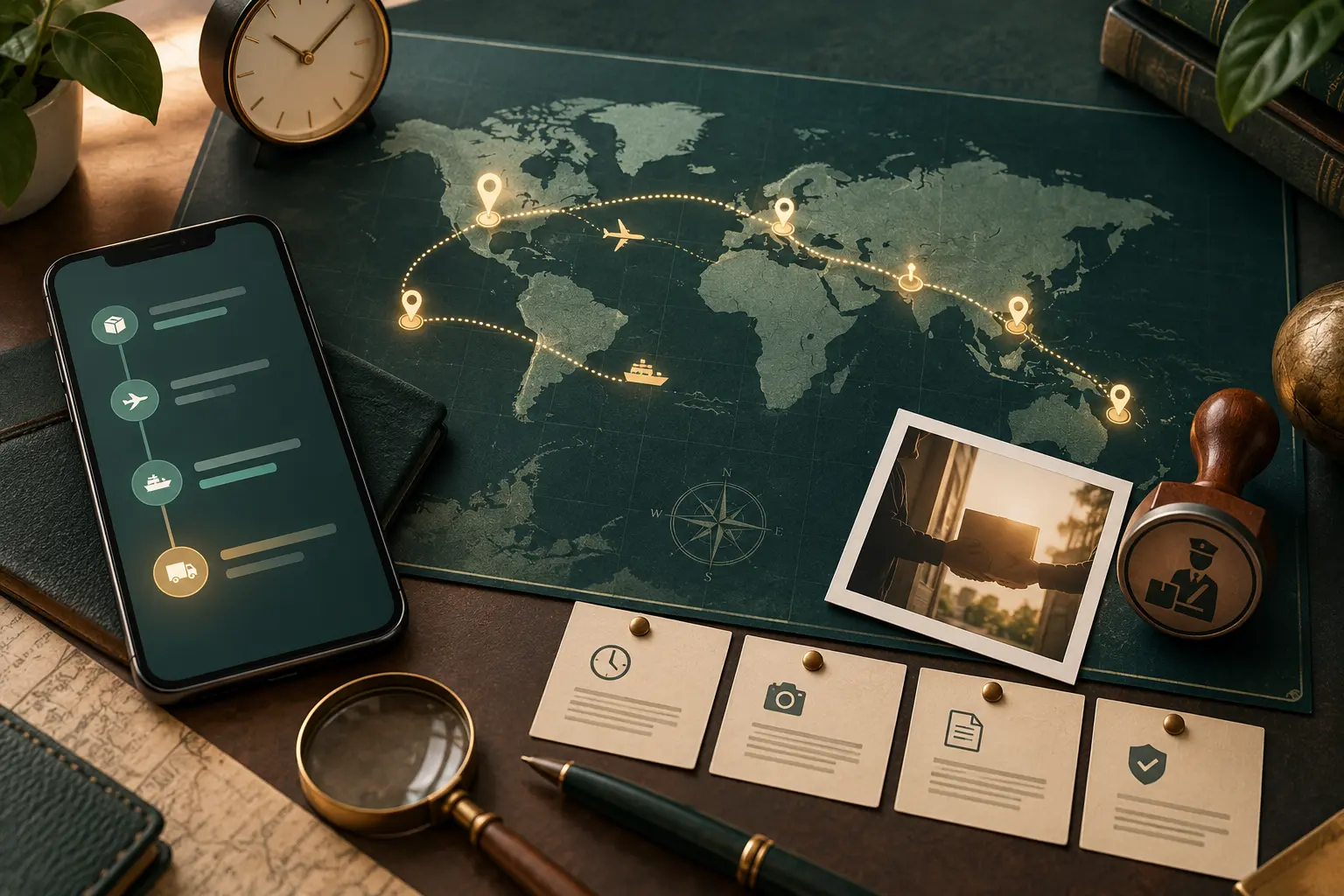
Start with the parcel record, not a prediction
Once an international parcel leaves the Superbuy warehouse, the useful question is not “When will it arrive?” but “What has been recorded, by whom, and at which stage?” Superbuy’s public guidance directs buyers to User Center and My Parcel after dispatch. Its separate parcel-tracking tool accepts either a tracking number or a parcel number. Those two identifiers should be the first cells in a tracking log, together with the Superbuy parcel ID, selected route, destination country and dispatch date shown in the account.
Copy the status exactly before interpreting it. Record the event time, location, source and the time you checked it. A screenshot alone is weak because it can hide the page, timezone or later changes; a typed row makes scans comparable. Do not convert a route estimate into a promised delivery date. International transport can involve third-party logistics companies and customs, and Superbuy explicitly notes that delays, taxes, confiscation, damage and missing parcels can occur outside its direct control. Your log should reveal movement and gaps without pretending to predict what the next scan must be.
Build one timeline from several tracking views
Begin with My Parcel because it connects the logistics record to the correct Superbuy submission. Then check the public Superbuy tracking page using the parcel or tracking number. When the page identifies an external carrier, compare the carrier’s own record. Superbuy also lists links to major postal and express operators, but the relevant operator depends on the selected route and the handoff shown for your parcel.
Use five columns: event time, reported location, exact status, reporting system and your plain-language note. Keep duplicate events rather than deleting them; two systems may import the same scan at different times. If the wording conflicts, preserve both versions and avoid choosing the more reassuring one. A route can also generate a second or local tracking number after handoff. Store it in a separate identifier field and note where it came from. Never publish tracking numbers or send them to unrelated parties. They are evidence tied to the shipment, and access should be limited to the carrier, Superbuy support and the recipient who needs to investigate it.
Read tracking as a chain of custody
Status labels vary, so group them by operational stage rather than memorizing every phrase. The first group covers data creation: label information received or shipment details submitted. That proves a record exists, not necessarily that the carrier has physically accepted the parcel. The second group covers origin handling: collection, acceptance, sorting and export preparation. The third covers international movement and border processing. The fourth is a destination handoff, followed by local sorting, delivery attempt and delivery.
A long gap means different things in different stages. No scan after label creation calls for confirmation that physical handoff occurred. Silence after export may reflect line-haul movement where intermediate scans are limited. A destination-arrival event followed by no local update may require the local carrier or customs channel identified in the record. A delivery attempt needs address, access and notice checks. This classification is not a diagnosis; it tells you which evidence and organization are relevant. Add a “last custody stage” column so a support request can say where the visible chain stopped instead of merely stating that tracking has not changed.
Distinguish a quiet route from an actionable exception
Do not use an arbitrary number of silent days for every route. Compare the latest scan with the live information in your account, the carrier’s current record and any route notice. Weekends, customs processing, consolidated transport and data handoffs can affect the apparent gap. Equally, do not keep waiting because an old estimate has not yet expired when the status itself shows an exception, an address problem, a failed delivery or a request for action.
Create three review levels. “Observe” means the parcel is moving and no action is requested. “Verify” means the two tracking sources disagree, a handoff number is missing, or a normal-looking scan has remained unchanged long enough to check current route guidance. “Escalate” means the record explicitly requests information, shows an unsuccessful delivery requiring a response, cannot be tracked after dispatch, or presents a delivery result that conflicts with the recipient’s evidence. Record why you changed the level. This prevents anxious daily messages while ensuring a concrete exception is not buried inside a generic progress page.
Prepare a logistics enquiry that can be investigated
Superbuy’s help center provides logistics enquiries and asks users to include the relevant order number or username so an issue can be handled efficiently. For a parcel case, lead with the parcel number, tracking number, account username, route and destination. Then give the last visible event with its time and source. State the requested outcome as a question: confirm physical carrier acceptance, identify the destination carrier, check the next required action, or investigate a delivery discrepancy.
Attach a short evidence set, not an unfiltered folder. Include the My Parcel screenshot, the carrier result, the relevant timeline rows and any notice received by the recipient. Name files by date and source. If the tracking page returns nothing, capture the entered identifier and result without exposing unrelated account details. Avoid asserting that the parcel is lost unless the responsible service has established that conclusion. “No update since the export scan shown on this date” is precise; “lost for two weeks” mixes observation with a claim. One clean chronology reduces the back-and-forth needed to understand the case.
Document customs and local-carrier handoffs carefully
Customs is not simply another carrier scan. A status may indicate presentation, clearance, release or a need for recipient action, but the exact wording and responsible authority matter. Record notices, reference numbers and requests separately from movement events. Never pay a charge through a link in an unsolicited message until the request has been verified through the official carrier or authority channel associated with the parcel.
At destination, find the local tracking number only from a trustworthy shipment record. Write down the carrier name, new identifier and the first scan where the handoff appears. If the local carrier requests an address correction or collection, save the request and the action taken. Do not change delivery instructions through random tracking aggregators. A handoff table is especially valuable when Superbuy shows one identifier, the international partner shows another, and the last-mile operator uses a third. The parcel may be moving normally even when one page stops importing new events; the joined timeline exposes that instead of making the older page look like the final truth.
Treat “delivered” as a verification step
A delivery scan closes the carrier’s visible route, but it does not replace recipient checks. Record the delivery time, location description, recipient or signature information shown, and any proof image available from the official carrier. Ask the household, reception desk, parcel room or authorized pickup point before alleging non-delivery. Photograph the parcel before opening if the outer packaging is wet, crushed, opened or resealed, and capture the label in a way that proves it is the correct parcel without sharing it publicly.
For missing contents or damage, preserve the outer packaging, internal protection, label and item condition in one continuous evidence set. Compare received contents with the parcel and warehouse records. Superbuy’s guide says users can confirm delivery in User Center and My Parcel, and can select the relevant parcel to apply for after-sales service when there is a question. Do not confirm a clean resolution before completing the checks that matter to your case. At the same time, a delivery scan alone does not prove warehouse error, carrier loss or theft; the evidence should show where the discrepancy becomes visible.
Close the log with a reusable case summary
When the parcel arrives or the enquiry is resolved, add the outcome, resolution date and the source that confirmed it. Keep the original timeline unchanged and add corrections as new notes. This preserves what was known at each decision point. A compact case summary should include identifiers, route, dispatch date, first carrier acceptance, major handoffs, last-mile carrier, delivery or exception date, actions taken and result.
The log is useful beyond one shipment. After several parcels, review where visibility repeatedly drops and which route descriptions, destination handoffs or delivery arrangements create avoidable uncertainty. Use those observations as questions before selecting a future route, not as universal claims about speed. Tracking discipline cannot prevent customs action, carrier delay or damage. It can prevent a second problem: reaching support with an incomplete story after screenshots have disappeared and identifiers have been mixed up. The goal is a factual chain of custody that another person can understand in minutes and investigate without guessing.
Questions buyers ask after a parcel is dispatched
Where can I track a Superbuy parcel? +
Superbuy directs users to User Center and My Parcel after dispatch. Its public parcel-tracking page also accepts a tracking number or parcel number.
Why do Superbuy and the carrier show different events? +
Systems may import scans at different times or use different wording. Keep both records, identify the source and look for a trustworthy handoff or local tracking number.
Does a tracking gap mean the parcel is lost? +
No. It shows that the visible record has not changed. Interpret the gap by stage and current route information, and escalate when there is a concrete exception or an appropriate enquiry is needed.
What should I include in a logistics enquiry? +
Include the parcel and tracking numbers, username, route, destination, exact last event, screenshots from relevant systems and one clear question.
Should I use a third-party tracking website? +
Prefer My Parcel and the official carrier identified by the shipment. Do not enter identifiers or change delivery instructions on an unverified site.
What if tracking says delivered but I cannot find it? +
Check the official proof, household, reception, parcel room and authorized pickup locations, then preserve that evidence and raise the discrepancy through the relevant parcel channel.
When should I photograph a delivered parcel? +
Photograph it before opening when packaging is damaged, wet, opened or resealed. Preserve the label, outer packaging, internal protection and contents.
Can Superbuy guarantee the third-party carrier’s service? +
Superbuy’s public guidance says international logistics and customs risks can fall outside its control. It offers assistance when problems occur, but buyers should not turn an estimate into a guarantee.
Written from current public Superbuy parcel tracking, customer service and shopping-agent guidance checked on September 9, 2026. Tracking sources, route notices, enquiry requirements and after-sales terms can change; the live Superbuy account, official carrier record and applicable policy should control a real case.